
A deterministic activation gate for high-risk beneficiaries and payout destination changes.
Approval proves it was allowed. LucidLock verifies it is still allowed before activation.

Account takeover gets them inside.
Beneficiary change lets them move the money.
LucidLock controls the moment that change becomes real.
Block
Unauthorised
Activation
Stop changed beneficiary or payout details before they become active.
Verify
Live
Authority
Check signature, replay status, expiry, policy, and live account state.
Create
Audit
Evidence
Record why activation was allowed or blocked at the final boundary.
LucidLock controls the dangerous moment before payout details become active
How It Works

1. Change Requested
A beneficiary or payout destination is added or updated.

2. Proof
Bound
Approval, policy context, account details, and request data are digitally bound.

3. Activation Checked
LucidLock verifies the request is authorized, unchanged, unreplayed, unexpired, and state-consistent.

4. Allow or
Block
If anything fails, activation is blocked. Fail-closed.
Beneficiary Activation Gate
Prevent high-risk beneficiary and payout destination changes from becoming active unless authority still holds.
See LucidLock Work
LucidLock already has a working prototype that demonstrates the execution verification pipeline.
It shows how high-risk financial changes can be blocked when authority no longer holds.
Demo scenarios include:
✅ changed beneficiary after approval
✅ replayed request
✅ expired approval
✅ policy violation
✅ live state mismatch
If the check fails, activation is blocked.
Why LucidLock is Different
Activation control, not just fraud detection
Verifies authority at the final boundary
Blocks replayed, expired, mutated, or state-inconsistent changes
Fail-closed by default
Creates audit evidence for every decision
Frequently Asked Questions
Explore Our Common Queries and Solutions
What problem does LucidLock solve?
LucidLock prevents high-risk beneficiary and payout destination changes from becoming active when authority, request details, replay status, policy, or live system state no longer match.
Is this account takeover prevention?
No. LucidLock does not stop someone getting into an account. It controls what can become active after access has been gained.
How is this different from fraud scoring?
Fraud tools detect suspicious behavior. LucidLock enforces activation control. If the change is not valid at the final boundary, it does not become active.
Where does LucidLock integrate?
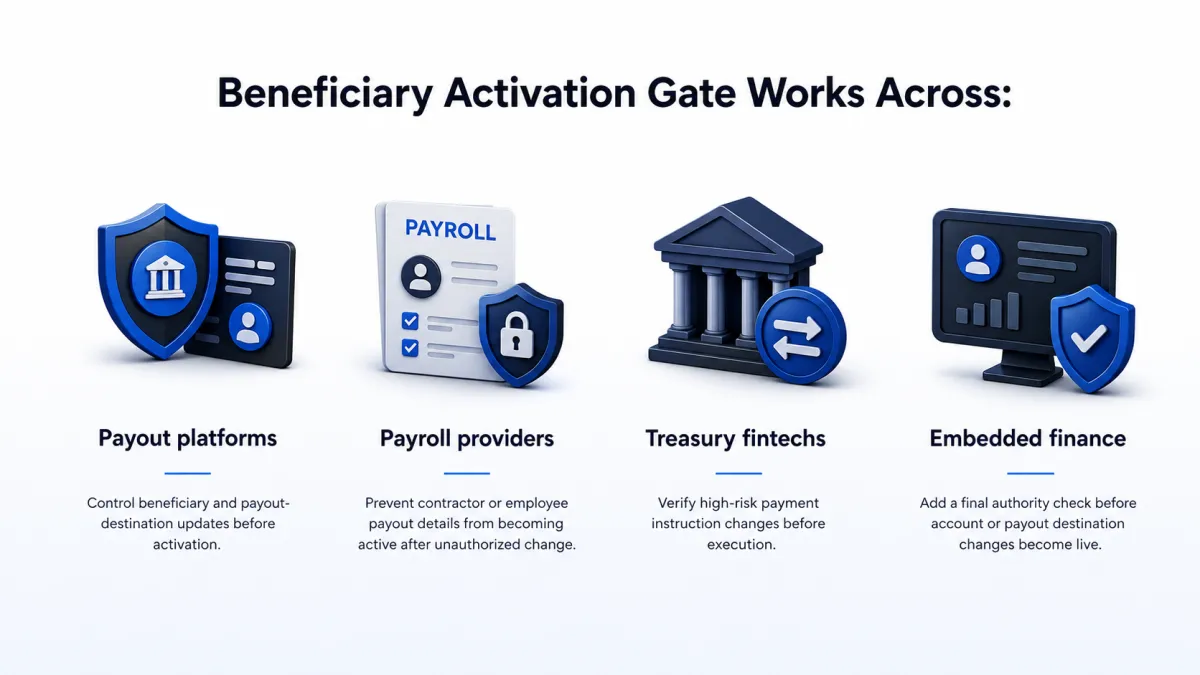
LucidLock sits before beneficiary, account, or payout destination changes become active. It can run as an API/service layer inside payout, treasury, payroll, or embedded finance workflows.
What happens if a check fails?
Activation is blocked and logged. LucidLock is designed to fail closed.
Is this only for beneficiary changes?
That is the first wedge. The same control expands into payouts, refunds, withdrawals, payment retries, automated finance workflows, and agentic financial execution.
Is LucidLock patented?
LucidLock is protected by multiple patent-pending filings covering its execution-time authority control architecture.
This includes proof-bound validation, replay protection, live state checks, fail-closed activation control, and forensic audit traces.
Ready to Control Beneficiary Activation Risk?
LucidLock helps payout platforms, payroll providers, treasury fintechs, embedded finance companies, and banks block invalid beneficiary and payout changes before they become active.

© 2026.LucidLock. All rights reserved.
Privacy Policy
Terms of Use